
Broadcasters continually optimize their transmissions—whether through frequency shifts, encryption changes, or beam realignments—to deliver higher quality, wider coverage, and new content efficiently.
These ongoing modifications mean that even the most reliable receivers can lose channels overnight if their stored parameters become outdated.
This is where accurate, timely frequency information becomes essential: a single correct entry of frequency, symbol rate, polarization, and FEC can instantly restore crystal-clear access without endless blind scans.
Successful satellite reception is influenced by multiple factors, including your geographic location within the satellite’s footprint, dish alignment, LNB quality, and weather conditions.
By providing clear, verified, and up-to-date tuning details for major satellites such as Nilesat, Arabsat, Eutelsat, Hotbird, Astra, and others, we aim to simplify the process and put control back in your hands.
Whether you’re troubleshooting a missing channel, adding a new package, or setting up a receiver from scratch, reliable satellite data ensures you spend less time searching and more time enjoying uninterrupted entertainment.
At the heart of this system lies a delicate balance of orbital mechanics and radiofrequency engineering: satellites positioned 36,000 kilometers above the equator beam signals downward in focused patterns known as footprints, while receivers on the ground must lock onto these signals using exact frequency and modulation parameters.
Broadcasters periodically refine their transmission characteristics—shifting frequencies to avoid interference, altering symbol rates for better data throughput, updating encryption systems, or expanding beam coverage—which inevitably affects millions of existing installations unless promptly addressed.
Many viewers encounter sudden channel loss or poor reception quality precisely because their stored parameters no longer match current satellite configurations, highlighting the critical need for reliable, timely sources of technical information.
This detailed guide addresses that need by compiling the most recent and thoroughly checked frequency tables for leading satellites worldwide, complete with practical tips for manual entry, enabling you to restore and maintain superior reception tailored to your specific location and equipment.
Fox Sports 1 (FS1), a flagship channel of Fox Corporation, is a leading sports network delivering high-energy coverage of major events, including NFL, MLB, NASCAR, UFC, and college sports, alongside popular studio shows like Undisputed and The Herd with Colin Cowherd.
Launched in 2013, FS1 targets sports fans with live broadcasts, expert analysis, and engaging commentary, primarily in English, catering to audiences in the Americas.
As of July 2025, FS1 is available via satellite in Latin America through Intelsat 21 (58°W), offering premium sports content to cable and satellite providers.
This article provides a detailed guide to the Fox Sports 1 frequency on Intelsat 21 (58°W), along with reception tips for viewers in Latin America. 📡⚾
Why Fox Sports 1 Stands Out 🌍
-
Dynamic Sports Coverage 🏈: Broadcasts major leagues (NFL, MLB, NBA), motorsports (NASCAR), combat sports (UFC), and college football/basketball, featuring events like the Big Ten and Pac-12 championships.
-
Engaging Studio Shows 🎙️: Offers programs like Undisputed with Skip Bayless and Speak with Joy Taylor, delivering lively debates and insights for sports fans.
-
Latin American Reach 🌐: Available in Latin America via Intelsat 21, serving providers like Claro TV, DirecTV, and Sky, with Spanish commentary for select events.
-
High-Quality Broadcasts 📺: Delivers HD (1920×1080) streams with Dolby audio, ensuring immersive viewing for sports enthusiasts.
-
Massive Audience 📈: Reaches millions across the Americas, with FS1 ranking among the top sports networks in the U.S. and Latin America for viewership.
Fox Sports 1 Frequency on Intelsat 21 (58°W) 📡
Fox Sports 1 is transmitted via Intelsat 21 (58°W), a satellite primarily serving Latin America with robust C-band coverage for cable headends and pay-TV providers. As of July 2025, FS1 is typically encrypted, requiring a subscription through authorized providers. Below is the latest frequency information for Fox Sports 1 on Intelsat 21, based on available data and industry-standard satellite configurations.
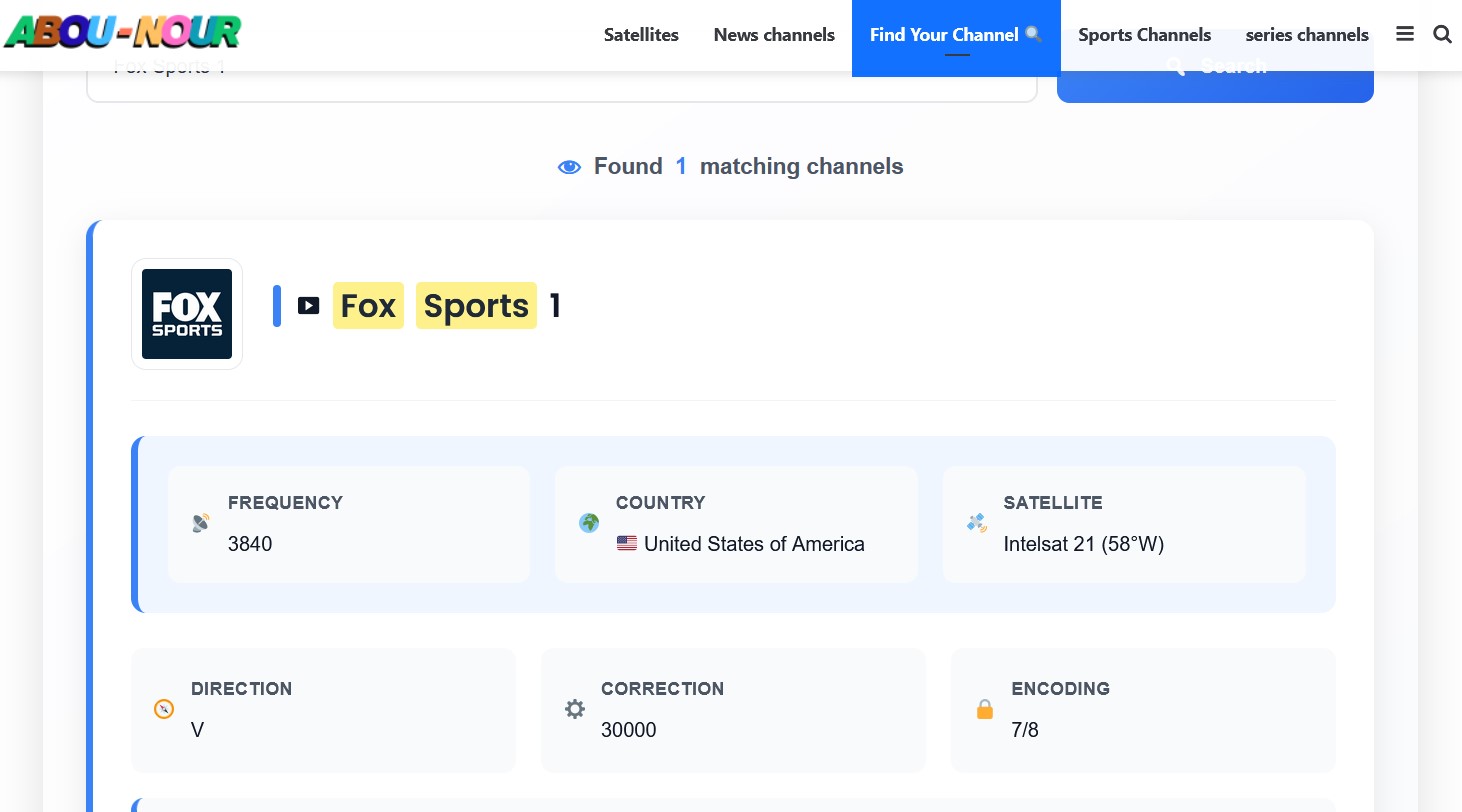
Frequency Table for Fox Sports 1 on Intelsat 21 (58°W) 2025 📊
|
Satellite |
Frequency |
Polarization |
Symbol Rate |
FEC |
Coverage |
Details |
|---|---|---|---|---|---|---|
|
Intelsat 21 (58°W) |
3840 MHz |
Vertical (V) |
30000 kS/s |
7/8 |
Latin America (C-band) |
DVB-S2, 8PSK, HD, encrypted (PowerVu), Fox Sports 1 HD. 📺 |
Key Information 🔍
-
Intelsat 21 (58°W): Fox Sports 1 HD is available on 3840 MHz, primarily for cable and satellite providers like Claro TV and DirecTV in Latin America, delivering content such as NFL games and UFC fights.
-
Encryption Note 🔒: The channel is encrypted using PowerVu, requiring a professional receiver and an authorized subscription from a pay-TV provider. Not available as free-to-air.
-
Coverage 🌎: Intelsat 21’s C-band beam covers most of Latin America, including Brazil, Mexico, Argentina, and Colombia, with strong signals for professional setups.
-
Alternative Satellites 🛰️: FS1 is not confirmed on Nilesat, Arabsat, or Hot Bird, as these satellites focus on MENA and European markets. In the U.S., FS1 is available via domestic satellites like SES-11 (105°W), but this is outside Intelsat 21’s scope.
-
Streaming Option 🌐: For viewers in Latin America, FS1 content may be accessible via streaming platforms like Fox Sports App or provider apps (e.g., Claro Video), subject to regional availability and subscriptions.
-
Note on Availability ⚠️: Frequency details may vary by provider or region. Contact your local pay-TV operator (e.g., Sky, DirecTV) to confirm transponder settings and channel access.
Optimizing Reception: Expert Tips for Flawless Viewing 📺
To access Fox Sports 1 on Intelsat 21 (58°W) with professional-grade reception, follow these expert tips tailored for Latin American viewers and cable operators:
-
Dish Size Selection 📏: Use a 1.8-2.4 m C-band dish for Intelsat 21 in Latin America to ensure strong signal reception, especially in areas with heavy rain fade.
-
Precise Dish Alignment 🧭: Align your dish to Intelsat 21’s orbital position (58°W) using a satellite finder or professional tools like SatFinder Pro. Ensure a clear line of sight, free from obstructions like buildings or trees.
-
LNB Compatibility 🔌: Install a C-band LNB (3.7-4.2 GHz) with a low noise figure (e.g., 15K). Confirm your receiver supports DVB-S2 and 8PSK for HD broadcasts.
-
Signal Optimization 📶: Aim for 70-90% signal quality on your receiver’s meter to prevent pixelation. Fine-tune dish azimuth, elevation, and LNB skew for peak performance. Use a spectrum analyzer for professional setups.
-
Weatherproofing ☔: Protect against signal loss in tropical climates by using weatherproof LNB covers and securing the dish with sturdy mounts. Avoid adjustments during heavy rain or storms.
-
Receiver Configuration ⚙️: Use a professional-grade receiver (e.g., Amiko, TBS) compatible with PowerVu decryption. Ensure your subscription with a pay-TV provider is active for authorized access.
Tuning Fox Sports 1 on Your Receiver: A Step-by-Step Guide 📡
For cable operators or viewers with professional satellite setups, add Fox Sports 1 to your receiver (e.g., Dreambox, Technisat) using these steps:
-
Access the Menu ⚙️: Press “Menu” or “Settings” on your remote, then select “Installation,” “Channel Search,” or “Transponder Setup.”
-
Select Manual Scan 🔎: Choose “Manual Scan” or “Add Transponder.”
-
Choose the Satellite 🛰️: Select Intelsat 21 (58°W). If unavailable, manually enter the orbital position.
-
Input Transponder Details 📋: Enter the frequency (3840 MHz), polarization (Vertical), symbol rate (30000 kS/s), and FEC (7/8). Verify accuracy.
-
Run the Scan 🔄: Press “Scan” or “OK.” Select “All Channels” for encrypted feeds. The scan takes 1-3 minutes.
-
Save Channels 💾: Save the scanned channel (e.g., “Fox Sports 1 HD”) to your channel list.
-
Authorize Decryption 🔐: Contact your pay-TV provider to activate PowerVu decryption. Ensure your receiver’s CAM module or software supports PowerVu.
-
Test Playback 📺: Select Fox Sports 1 to confirm clear playback. If the signal is weak, adjust dish alignment to achieve 70-90% signal quality.
Receiver Tips 🔌:
-
Enable “LNB Power” in the transponder menu for C-band LNBs.
-
Confirm your receiver firmware supports PowerVu decryption and DVB-S2/8PSK.
-
Consult your provider for specific entitlement keys or smartcard requirements.
Fox Sports 1’s Regional Impact and Highlighted broadcasts 🌟
Fox Sports 1 continues to dominate sports broadcasting:
-
Viewership Strength 📈: FS1 reaches over 80 million households in the U.S. and millions more in Latin America via providers like DirecTV and Claro, solidifying its status as a top sports network.
-
Iconic Programming 🎤: Features live events like NFL’s Thursday Night Football, MLB World Series, UFC Fight Nights, and college sports, plus studio shows like Undisputed and The Herd.
-
Latin American Appeal 🌎: Offers Spanish-language commentary for select events (e.g., MLB games), catering to Latin American audiences via Intelsat 21.
-
Digital Innovation 📱: The Fox Sports App (foxsports.com) provides live streaming and highlights, accessible with provider credentials in supported regions.
-
Historical Milestone 🏛️: Launched in 2013 as a competitor to ESPN, FS1 replaced Speed Channel, expanding Fox’s sports portfolio with high-profile acquisitions like NFL and FIFA World Cup rights.
Clarification: Fox Sports 1 vs. Other Sports Channels
Fox Sports 1 focuses on U.S. and international sports like NFL and UFC, while beIN Sports emphasizes soccer (e.g., La Liga).
Rai Gulp and Minika Çocuk target kids with non-sports content. Fox Sports Middle East, often mentioned on Nilesat, is a distinct regional channel unavailable on Intelsat 21.
FS1’s Intelsat 21 feed is tailored for Latin American pay-TV providers, not MENA or European markets.
We extend our genuine appreciation for your trust in our resource, hoping that the information shared has not only resolved any existing issues but also enhanced your overall viewing experience through clearer signals and more stable connections.
The dynamic nature of satellite transmissions necessitates continual vigilance, and we take pride in serving as your dependable partner in navigating these evolutions, ensuring you never miss out on important content due to outdated configurations.
Your active participation through feedback and shared experiences plays a crucial role in refining our content, helping us better serve the broader community of satellite television users.
In case you have any problem, you can contact us by leaving a comment below the article, and our support team will respond to you with the correct information as soon as possible, providing step-by-step assistance to overcome any obstacles you may encounter.
We sincerely hope that this information has restored the channels you were missing to your screens, and that you are now enjoying clear and stable live broadcasts covering all areas, from sports and news to entertainment, religious, and cultural programs.
The world of satellite broadcasting is witnessing continuous and rapid changes, whether due to updates from operating companies, the launch of new channels, or modifications to broadcast packages, making it essential for all satellite reception enthusiasts to follow these changes.
Our team exerts great effort daily to track everything new on popular satellites such as Nilesat, Arabsat, Eutelsat, Hotbird, Astra, and others, ensuring that the information we publish is up-to-date and reliable before the changes affect your devices.
We know well that the tuning process can vary from one receiver to another, and that signal strength is influenced by geographic location, weather, and the accuracy of dish alignment, which is why we always try to provide explanations in a simplified manner that covers all possible scenarios.
If you have successfully added the frequencies easily and your reception has become perfect, this makes us very happy; and if you face any challenge, no matter how small, remember that we are partners in this experience and welcome all your inquiries.
Your comments and feedback represent a valuable source for us to improve the content, whether they are successful experiences that encourage others or specific issues that help us provide more customized solutions in upcoming articles.
In case you have any problem, you can contact us by leaving a comment below the article, and our support team will respond to you with the correct information as soon as possible, along with practical suggestions tailored specifically to your device and your region.
We thank you profusely for your trust and continued follow-up, and we promise to keep delivering high-quality content that keeps you always informed of everything new in the world of satellite channels—so stay with us and enjoy enjoyable, uninterrupted viewing.
The thoroughly researched and freshly updated parameters presented throughout this article represent our unwavering commitment to delivering actionable intelligence that transcends regional boundaries and device limitations.
We genuinely anticipate that implementing these details has revitalized your channel lineup, bringing back vibrant picture quality and robust audio across all your preferred genres and broadcasters.
Our ongoing surveillance of transponder activities across major satellites ensures that future updates will continue to preempt potential disruptions before they affect your viewing routine.
We deeply value the vibrant community of satellite enthusiasts who contribute their knowledge and experiences, enriching the collective understanding of this fascinating technology.
Your success stories inspire us, while any reported difficulties guide our improvements in clarity and comprehensiveness.
In case you have any problem, you can contact us by leaving a comment below the article, and our support team will respond to you with the correct information as soon as possible, dedicated to achieving perfect reception for every user.